

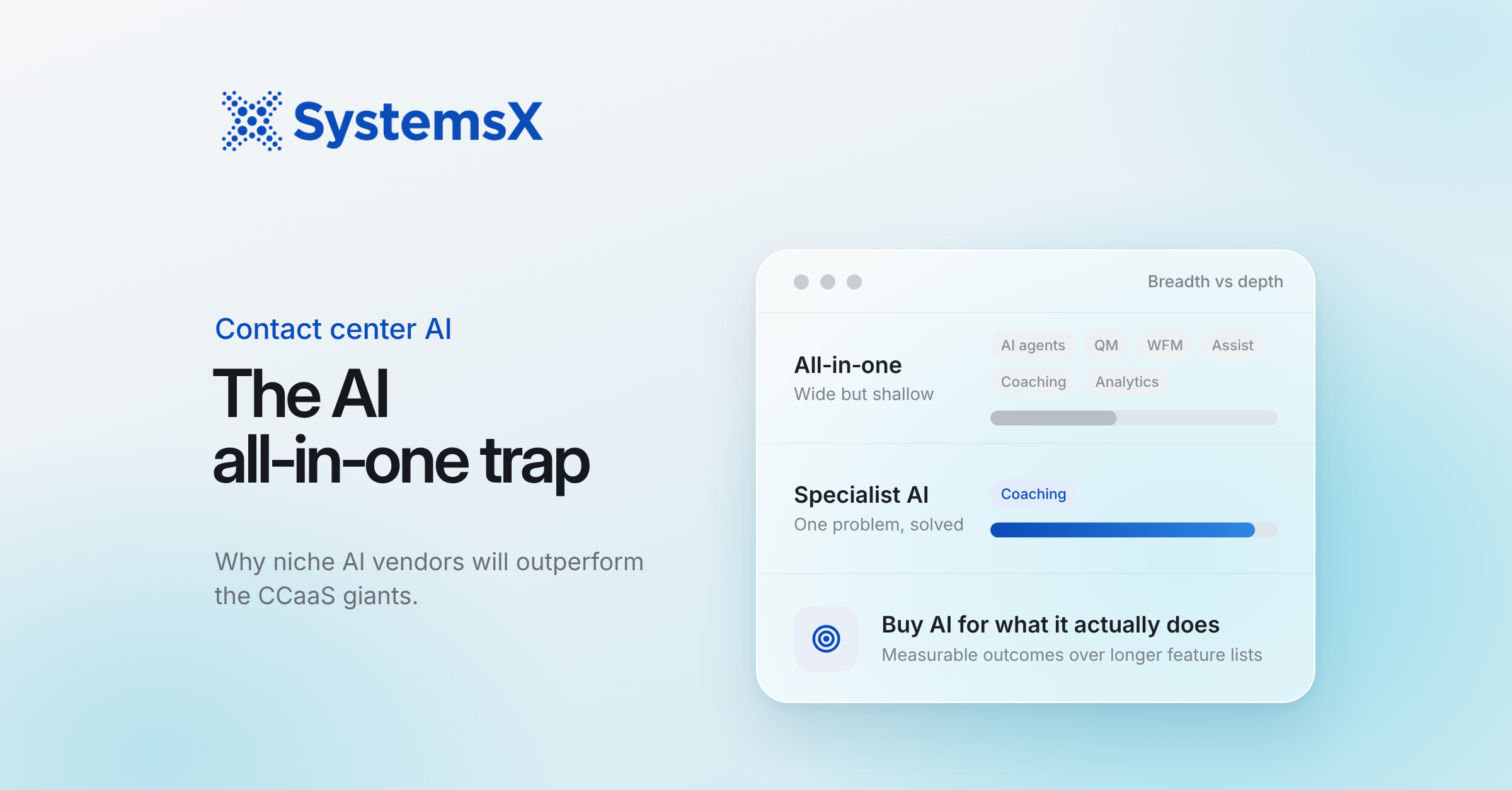
In the race to transform the contact center with AI, the biggest platform doesn’t automatically win. Sometimes, the vendor focused on solving one problem exceptionally well is the one that delivers the greatest value.
The contact center industry is moving through a massive transformation. CCaaS providers are racing to add AI agents, agent assist, automated quality management, workforce optimization, analytics, coaching, and customer engagement tools to their platforms.
On paper, the strategy makes sense. Why buy five solutions from five vendors when one platform promises to do everything?
But there’s a fundamental question that contact center leaders should be asking:
Can a vendor that has to build, maintain, integrate, and continuously improve every part of the contact center really be the best at all of them?
I believe the next generation of contact center AI will be defined not by the companies that offer the most features, but by the companies that solve specific problems exceptionally well.
The CCaaS Challenge: Everything Is a Product
Consider what a CCaaS provider must accomplish to deliver a comprehensive AI portfolio.
It isn’t simply a matter of adding a feature to an existing platform. Every solution represents its own set of technical, operational, and commercial challenges.
To deliver an effective AI-powered contact center, a provider may need to:
* Build and maintain conversational AI. Develop voice and digital agents that understand customer intent, manage complex conversations, connect to enterprise systems, recover from errors, and complete transactions reliably.
* Solve speech recognition and language understanding. Account for accents, background noise, interruptions, multilingual conversations, industry terminology, and the unpredictable ways real customers communicate.
* Deliver agent assist. Capture conversations in real time, surface relevant information, recommend responses, and provide accurate guidance without introducing latency or distracting agents.
* Develop automated quality management. Evaluate interactions consistently, understand context and intent, identify compliance violations, score performance, and give supervisors reliable insights across thousands or millions of conversations.
* Create workforce optimization capabilities. Forecast demand, schedule agents, manage adherence, and connect operational planning with constantly changing customer volumes.
* Build effective coaching and training. Identify skill gaps, simulate realistic customer interactions, tailor coaching to individual agents, and demonstrate whether training actually improves performance.
* Manage analytics and data infrastructure. Process enormous volumes of voice and digital interactions, normalize data, maintain reporting accuracy, and make insights useful across teams.
* Integrate with enterprise technology. Connect to CRMs, ticketing systems, knowledge bases, payment systems, back-office applications, and legacy infrastructure.
* Maintain security, compliance, and reliability. Support stringent requirements for privacy, data residency, access control, auditability, uptime, and regulated industries.
* Keep every capability competitive. Invest in research, engineering, product management, customer support, and continuous releases as models, competitors, and customer expectations evolve.
And that is before accounting for implementation, customization, customer-specific workflows, support, and the challenge of making every component work together.
Each of these categories is a business in its own right.
A company that excels at routing calls does not automatically excel at teaching an agent how to handle a difficult objection. A company that has mastered workforce scheduling does not automatically have the best technology for evaluating the intent and compliance of every customer conversation.
These capabilities require different expertise, different development priorities, and different measures of success.
The more products a platform promises to deliver, the more competing priorities it must manage.
That doesn’t mean CCaaS companies cannot build excellent AI products. It means buyers should evaluate each product on its own merits rather than assuming that a strong core platform guarantees excellence across the entire portfolio.
The Difference Between Having a Feature and Solving a Problem
This is where specialized AI vendors have an opportunity.
A niche vendor can concentrate its resources on a clearly defined problem, build deeper domain expertise, and continuously refine the solution based on actual customer outcomes.
Take automated quality management as an example.
A basic approach might analyze calls after they happen, apply a scorecard, and produce a report for a supervisor.
A more sophisticated approach could evaluate a much larger proportion of interactions, identify patterns across teams, detect emerging compliance risks, pinpoint specific skill deficiencies, and automatically recommend the next coaching intervention.
The difference isn’t simply the number of features. It is the depth of the solution and how effectively it addresses the operational problem.
The same principle applies to conversational AI, agent coaching, real-time agent assist, and customer engagement automation.
A specialist building AI agents for a particular workflow can focus on completing that workflow reliably. A specialist in agent coaching can concentrate on behavioral change, realistic simulations, and measurable improvements in agent performance.
Their roadmaps are driven by the problems they were created to solve.
That focus can translate into faster innovation, deeper functionality, and a more direct connection between technology and business results.
AI Is Not One Technology
One reason the all-in-one strategy is challenging is that AI is not a single capability that can be switched on across an existing platform.
Different applications have fundamentally different requirements.
A real-time voice agent must respond naturally, manage interruptions, maintain context, and execute actions with minimal latency.
An automated quality management engine must evaluate interactions accurately and consistently, often against complex criteria that vary by industry and customer.
An agent coaching platform must understand behavior, simulate realistic scenarios, and help people improve their performance.
An autonomous marketing system must determine whom to engage, when to engage them, what message to deliver, and how to adapt based on customer behavior.
These systems may share underlying AI models, but they require different orchestration, data, evaluation methods, safeguards, integrations, and product design.
The challenge is not merely connecting a large language model to an application. It is engineering the complete solution around the model.
That is why a generic AI capability does not automatically become a best-in-class AI product.
The Economics of Focus
There is also an economic argument for specialized vendors.
A large CCaaS provider must allocate capital across a broad portfolio. It has to support its core platform, satisfy existing customers, maintain integrations, protect margins, and compete across multiple product categories.
A specialized vendor has a narrower mission.
It can dedicate a greater proportion of its product and engineering resources to improving one capability. It can respond to customer feedback more directly, experiment with new approaches, and prioritize the use cases that matter most to its buyers.
This creates the potential for a different innovation cycle:
1. Focus on one high-value business problem.
2. Build a solution specifically for that problem.
3. Measure its performance against meaningful outcomes.
4. Learn from customer deployments.
5. Improve the product continuously.
6. Expand only when there is a compelling reason to do so.
The goal isn’t to build the smallest company. It is to build the most effective solution for the problem being addressed.
Of course, specialization does not guarantee success. A niche vendor still needs reliable technology, financial stability, strong security, customer support, and a credible long-term roadmap. Buyers should demand evidence, not just a compelling demo.
But when a specialist can demonstrate superior outcomes, its focused approach becomes a competitive advantage.
The Best-of-Breed Model Is Evolving
Historically, buying from multiple vendors could create a new set of problems: disconnected data, fragmented reporting, overlapping functionality, complicated integrations, and unclear accountability.
Those concerns are legitimate.
But the choice no longer has to be between a single vendor that owns every capability and a collection of disconnected point solutions.
Modern APIs, integration frameworks, shared data layers, and AI orchestration platforms make it increasingly practical to connect specialized capabilities into a cohesive operating environment.
The architecture can separate the underlying contact center infrastructure from the applications that improve how the contact center performs.
In this model, a company might use one platform for telephony and routing, another for conversational AI, another for automated quality management, and another for coaching and agent development.
The objective is not to maximize the number of vendors. It is to select the right technology for each important business problem while ensuring the solutions work together.
That requires thoughtful architecture, clear ownership of integrations, and disciplined vendor management. But it also gives organizations more flexibility to adopt better capabilities without replacing their entire contact center infrastructure.
The future may belong to integrated ecosystems of exceptional products rather than closed ecosystems of average ones.
What Buyers Should Really Be Asking
When evaluating a CCaaS provider’s AI portfolio, contact center leaders should look beyond the feature checklist.
Ask questions that reveal the actual depth of each capability:
* Does the product outperform alternatives on the specific problem we need to solve?
* Can the vendor demonstrate results in an environment similar to ours?
* How accurate, reliable, and fast is the solution under real operating conditions?
* How does it handle exceptions, complex workflows, and unexpected customer behavior?
* Does it improve continuously, or is it primarily a feature bundled into a larger platform?
* Can it integrate with our existing systems without forcing unnecessary infrastructure changes?
* Are the business outcomes measurable, and can we validate them through a controlled pilot?
* What happens if a better solution emerges in this category? Can we adopt it without rebuilding our entire environment?
These questions shift the conversation from platform consolidation to business performance.
Consolidation can reduce complexity and cost. But consolidation without evaluating product quality can also lock an organization into capabilities that are convenient rather than exceptional.
The right decision depends on the use case, the economics, the integration requirements, and the evidence.
The Future Belongs to the Best Solutions
CCaaS providers will remain important. They own critical infrastructure, maintain enterprise relationships, and offer the reliability and operational foundation that contact centers require.
The argument is not that these companies should stop innovating or that every specialist is superior.
It is that owning the contact center does not automatically mean owning the best AI for every part of it.
The companies that build the best conversational agents, the most effective coaching systems, the most accurate quality management engines, and the most intelligent customer engagement solutions may not all come from the same organization.
For buyers, that is an opportunity.
Instead of asking which vendor can sell them the largest portfolio, they can ask which combination of capabilities will produce the greatest improvement in customer experience, agent performance, operational efficiency, and revenue.
For specialized AI vendors, the opportunity is equally significant. They don’t have to replace the entire CCaaS platform to create substantial value. They need to solve an important problem better than the alternatives, prove the impact, and integrate into the environment where the customer already operates.
The next era of contact center AI will not necessarily be won by the company with the longest feature list.
It will be won by the companies that turn AI into measurable business outcomes.
Buy the platform for the foundation. Buy the AI for what it can actually do.
Because in a market where every vendor claims to do everything, the real differentiator will be who does the important things exceptionally well.
Thanks for reading,
Tarell Harrison
Head of Sales
SystemsX