

Everyone is talking about Auto QA, AI coaching, agent performance, compliance monitoring, sentiment analysis, and agentic AI.
But there’s a foundational layer that often doesn’t get nearly enough attention:
Transcription.
If that layer is wrong, everything built on top of it can be wrong, too.
Transcription isn’t simply converting speech into text. In an AI-powered contact center, it’s the foundation upon which the organization begins to understand, evaluate, coach, and act on customer conversations.
And the consequences of getting it wrong can extend far beyond an inaccurate transcript.
When a transcription error becomes an investigation
I’ve seen a real-world example where an agent used the word “bucket” during a customer interaction. The transcription system incorrectly interpreted the word as profanity. That transcription was then used to flag the agent for inappropriate language, triggering an investigation by the customer.
Think about the operational impact.
Managers had to stop what they were doing to investigate the incident. Time was spent reviewing the interaction, validating what was actually said, addressing the allegation, and dealing with the resulting escalation.
The customer’s organization was pulled into an investigation over something that never happened.
An entire day of productivity was disrupted because AI incorrectly interpreted a word.
The agent didn’t use profanity. The technology said they did.
This is the danger of allowing AI-generated transcripts to become the source of truth without validating their accuracy.
Now imagine that same error happening at scale across thousands of interactions.
1. Bad transcription creates bad quality evaluations
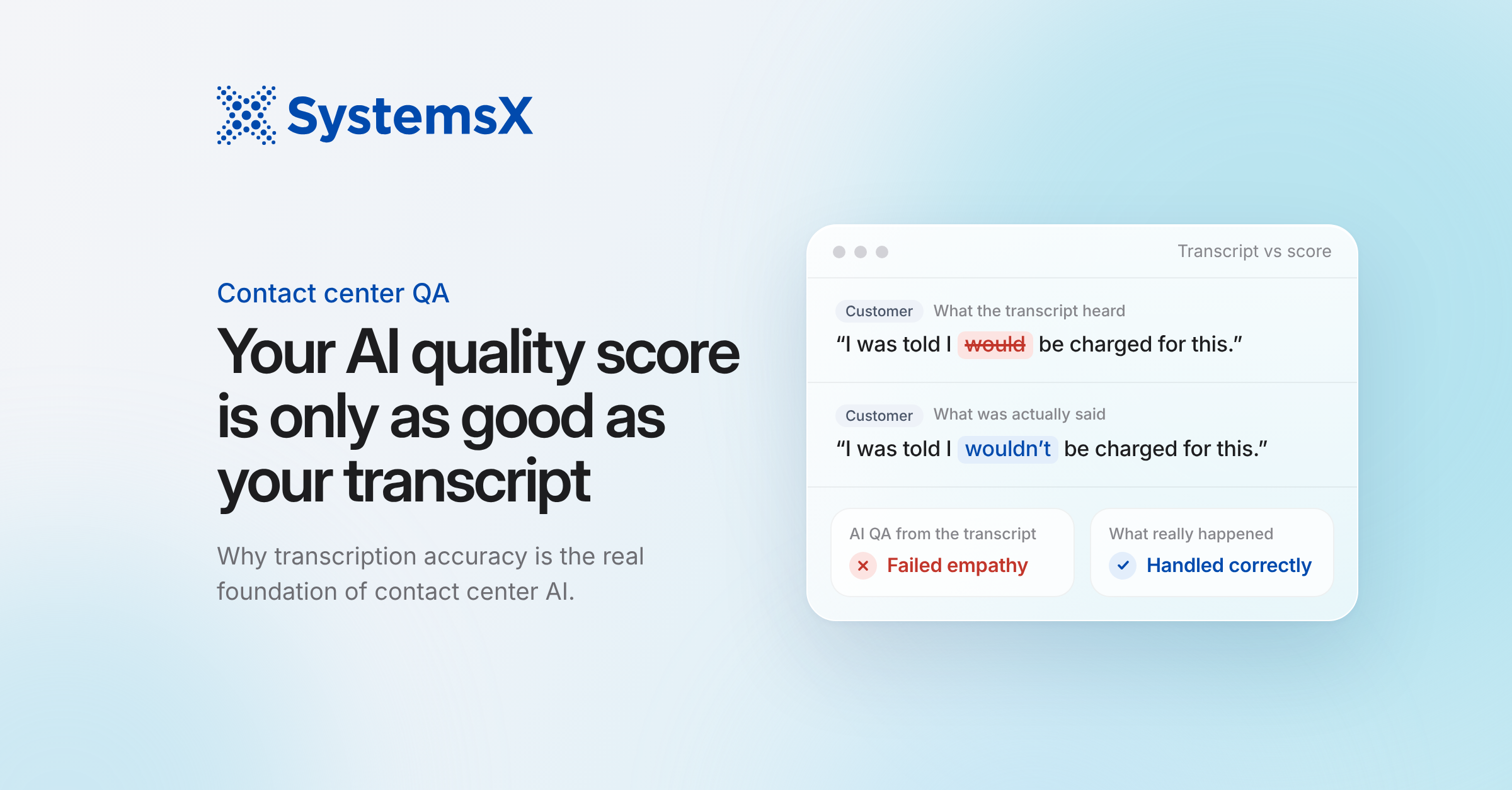
Imagine a customer calling about a billing dispute.
The customer says:
“I was told I wouldn’t be charged for this.”
The agent responds:
“I understand. Let me look into why you were charged.”
But the transcription engine misinterprets the conversation. The customer is now recorded as saying they were told they would be charged. The agent’s response is recorded inaccurately as well. A human listening to the recording understands the interaction.
But an automated quality management system evaluating the transcript may now conclude:
The customer acknowledged they expected the charge.
The agent failed to demonstrate empathy.
The agent failed to acknowledge the customer’s concern.
The agent didn’t properly resolve the customer’s confusion.
The agent could receive a lower QA score for a conversation they actually handled correctly.
Now multiply that across thousands or millions of interactions.
You’re no longer measuring agent performance accurately. You’re measuring a combination of agent performance and transcription errors.
2. Bad transcription creates bad coaching
Now imagine the same interaction feeds an AI coaching platform.
The system identifies that the agent failed to acknowledge the customer’s frustration and recommends:
“Improve empathy by acknowledging the customer’s concern before moving into problem-solving.”
The agent receives coaching based on something that never happened. This is a much bigger problem than a bad score.
When coaching is based on inaccurate conversations:
Agents lose trust in the coaching system.
Managers spend time validating false findings.
Coaching sessions focus on behaviors that didn’t occur.
Actual performance gaps go unidentified.
AI coaching should help agents become better at their jobs, not force them to defend themselves against mistakes made by another AI.
3. Bad transcription can create false compliance violations
Consider a compliance requirement that an agent must disclose a specific statement before completing a transaction.
The agent says:
“This call may be recorded for quality and training purposes.”
The transcription engine captures:
“This call may not be recorded for quality and training purposes.”
An automated compliance system may flag the agent for failing to provide the disclosure or interpret the conversation as an entirely different compliance event. The reverse is equally dangerous. An agent may omit a required disclosure, but transcription errors insert language that makes it appear the disclosure was completed.
Now the organization has false positives and false negatives.
Neither is acceptable when quality management, regulatory compliance, and customer protection are involved.
4. Bad transcription compromises the entire intelligence layer
The impact doesn’t stop at QA.
The same transcript may power:
Sentiment analysis: Misinterpreting frustration, satisfaction, or intent.
Customer intent detection: Incorrectly identifying why a customer contacted the organization.
Root cause analysis: Reporting inaccurate trends across thousands of interactions.
Agent performance analytics: Misidentifying behaviors and performance gaps.
Coaching recommendations: Reinforcing the wrong behaviors.
Knowledge and process adherence: Missing or falsely identifying steps taken during a conversation.
Customer journey analytics: Misrepresenting why customers call, escalate, churn, or convert.
AI-generated summaries: Providing managers with inaccurate accounts of customer interactions.
One inaccurate transcript can create multiple inaccurate conclusions. And when those conclusions are aggregated into dashboards, reports, trends, and management decisions, the original error becomes increasingly difficult to identify.
5. Transcription quality is more than word accuracy
A transcript can achieve a seemingly impressive accuracy rate and still fail operationally.
In contact centers, getting the words right is only part of the equation.
You also need to understand:
Context. Is the customer asking a question, making a statement, expressing frustration, or being sarcastic?
Speaker attribution. Did the customer say it, or did the agent say it? Confusing the two can completely change a QA evaluation.
Negation. Words like “did,” “didn’t,” “can,” “can’t,” “will,” and “won’t” can fundamentally change the meaning of an interaction.
Industry terminology. Names, products, account types, medications, insurance terminology, technical language, and company-specific processes can be difficult for generic transcription models.
Numbers and dates. Misinterpreting a dollar amount, account number, appointment date, payment amount, or reference number can create operational consequences.
Overlapping speech. Customers and agents frequently interrupt, talk over one another, or speak simultaneously. Losing the context of who said what matters.
Audio quality. Background noise, poor connections, accents, speaking speed, and microphone quality all affect accuracy.
A transcript that looks clean on a screen isn’t necessarily an accurate representation of the conversation.
6. Quality management needs to evaluate the conversation, not just the text
This is where the architecture and approach to AI matter. Transcription should not be treated as an isolated step that produces text and is then blindly consumed by every downstream application.
The system needs to understand the reliability of the underlying data.
Where uncertainty exists, it should be recognized. Where speaker attribution is uncertain, that uncertainty should matter. Where critical compliance language is detected or potentially undetected, the system should be able to validate the evidence rather than simply accepting a text-based conclusion.
The goal isn’t just to generate a transcript. The goal is to accurately understand what happened in the conversation and ensure the systems evaluating that conversation have reliable evidence to support their conclusions.
Because the quality of Auto QA isn’t just about how intelligent the evaluation model is.
It’s about whether the model was given an accurate representation of reality in the first place.
The bottom line
The contact center AI conversation is moving rapidly toward automated quality management, real-time coaching, agentic workflows, and intelligent operations.
But the more decisions we automate, the more important the foundation becomes.
Garbage in, garbage out isn’t just a data problem. In AI-powered contact centers, it becomes a people problem, a compliance problem, a performance problem, an operational problem, and ultimately a customer experience problem.
Before we ask AI to evaluate conversations, coach agents, identify trends, or make decisions, we need to make sure it understands the conversation.
That’s where everything starts.
Best regards,
Tarell Harrison