

Call centers have spent years investing in quality assurance, agent training, and AI-powered simulations. Yet one of the biggest challenges remains: how do we turn everything we learn from customer interactions into measurable improvements in agent performance?
The answer may be agentic coaching.
Traditional quality assurance tells us what happened. AI simulations give agents a place to practice. Coaching helps them understand what to improve.
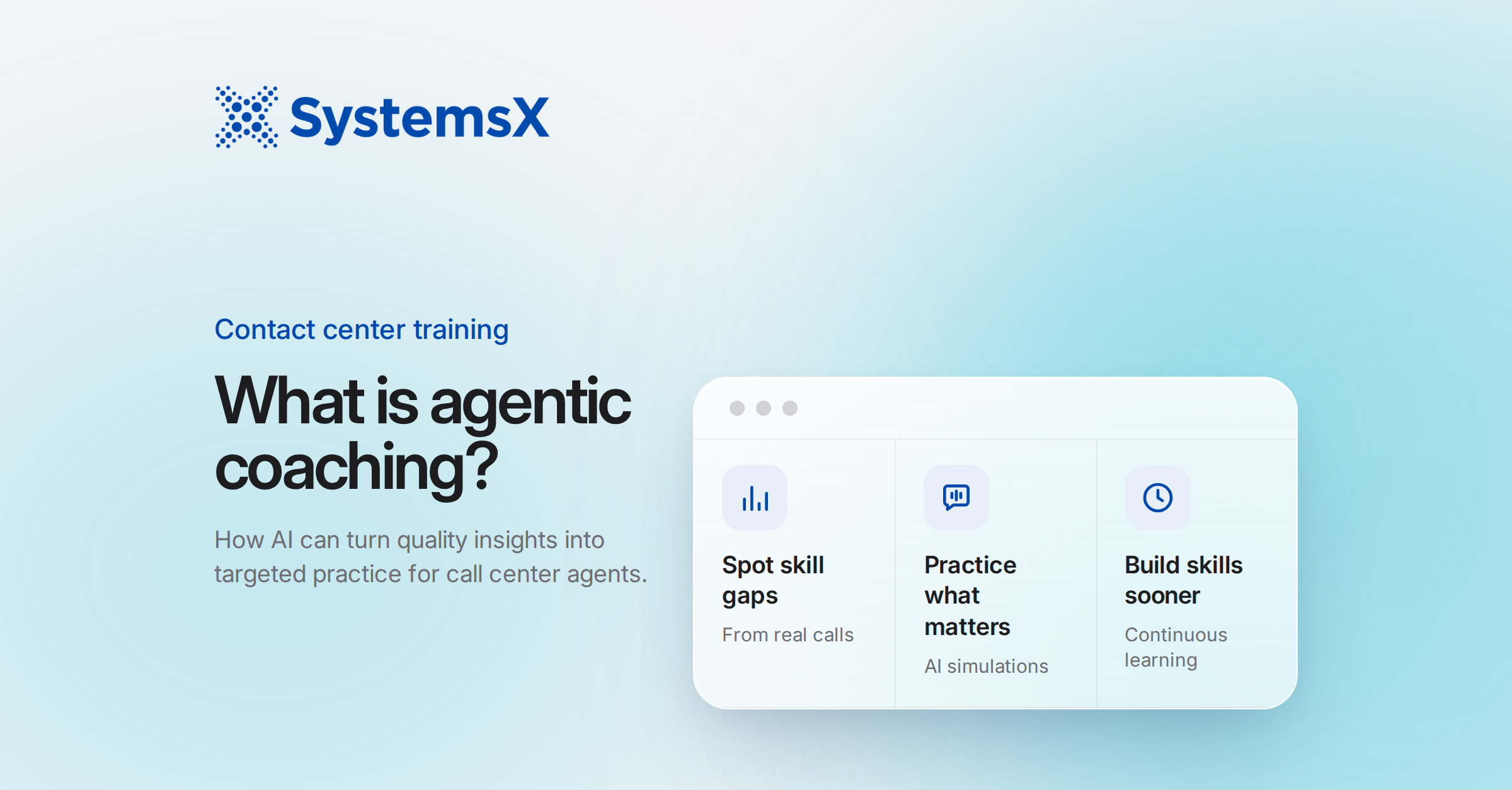
Agentic coaching connects all three, turning real customer interactions into a continuous cycle of learning, practice, and measurable improvement.
Instead of simply reporting on agent performance, AI can help determine what an agent needs to learn, build targeted coaching scenarios, and guide the agent toward better outcomes.
This is where the next evolution of AI in the contact center begins.
What Is Agentic Coaching in a Call Center?
Agentic coaching uses AI to help identify skill gaps, personalize training, generate relevant practice scenarios, and support ongoing agent development based on actual performance data.
Unlike traditional coaching workflows that depend on supervisors manually reviewing calls, identifying trends, and creating training plans, an agentic approach can connect these activities into a more continuous process.
For example, a quality assurance system might identify that an agent consistently struggles to handle customer objections. Instead of leaving that insight in a dashboard, an agentic coaching system can use it to create a targeted simulation in which the agent practices handling those objections.
The system can then evaluate the practice interaction, provide feedback, and help reinforce the skills that need improvement.
The goal is not simply to automate coaching administration. It is to make coaching more relevant, more timely, and more closely connected to the conversations agents have with customers every day.
Why Traditional AI Simulations Are Not Enough
AI-powered voice simulations have created new opportunities for contact center training.
Agents can practice difficult conversations, rehearse compliance requirements, and develop confidence before handling similar situations with real customers.
But simulations alone do not guarantee improvement.
If an agent completes a practice session without addressing the specific weaknesses appearing in their live calls, the business may be investing in training without resolving the underlying performance problem.
The missing piece is the connection between practice and actual work.
Agentic coaching changes the model by using real interactions to determine what agents should practice next. Rather than assigning the same exercises to an entire team, it can help tailor training to individual needs.
The result is a more targeted approach to learning, where simulations are not isolated events but part of an ongoing development process.
How Quality Assurance Becomes the Engine for Agentic Coaching
Quality assurance generates valuable information about what happens during customer interactions. It can surface compliance risks, missed opportunities, communication challenges, process errors, and recurring customer frustrations.
Historically, much of this information has been used for reporting, auditing, and performance management.
But what if QA became the starting point for the next coaching interaction?
An agentic coaching workflow can connect the dots:
Identify: AI analyzes quality data and real customer conversations to uncover recurring skill gaps.
Prioritize: The system identifies which behaviors need attention based on their impact on customer experience, compliance, and performance.
Personalize: AI creates coaching exercises and voice simulations that reflect the agent’s actual development needs.
Practice: The agent works through realistic scenarios and receives targeted feedback.
Reinforce: Subsequent interactions can be evaluated to determine whether the desired behaviors are improving.
Adapt: New quality findings help shape the next coaching opportunity.
This creates a continuous learning loop between the work agents perform, the feedback they receive, and the skills they develop.
The important distinction is that AI is not simply recommending more training. It is helping turn operational insights into actionable development.
How Agentic Coaching Can Reduce Time to Proficiency
Time to proficiency measures how long it takes an agent to consistently meet the performance expectations of their role.
For contact centers managing high hiring volumes, seasonal demand, complex products, or strict compliance requirements, reducing this period can have significant operational value.
However, measuring time to proficiency is not the same as actively reducing it.
Agentic coaching creates an opportunity to move from tracking progress to influencing it.
Consider a new agent who consistently struggles with authentication procedures and call control. A traditional approach might flag the issue during a quality review, schedule a supervisor coaching session, and wait for the next evaluation to determine whether the agent improved.
An agentic approach could identify the pattern, generate relevant practice scenarios, allow the agent to rehearse those interactions, and use subsequent performance data to assess progress.
The learning process becomes more immediate and more specific to the individual.
Over time, this approach could help contact centers reduce repetitive coaching work, deliver more consistent training, and accelerate the development of critical skills. The actual impact should be validated against measurable outcomes, including time to proficiency, quality scores, compliance, customer satisfaction, and supervisor effort.
Why Agentic Coaching Matters for the Future of Voice AI
Much of the conversation about voice AI focuses on customer-facing automation: how AI can answer calls, resolve issues, and reduce the need for human intervention.
Those applications have enormous potential, but there is another opportunity.
AI can make the people who continue to serve customers more capable.
Human agents handle situations that require judgment, empathy, adaptability, and an understanding of context. Helping those agents develop their skills faster can improve both the employee experience and the customer experience.
Voice AI simulations provide a way to practice. Quality assurance provides evidence of where improvement is needed. Agentic coaching connects these capabilities into a system designed to support continuous development.
This is also an important distinction for organizations that are cautious about deploying autonomous AI directly into customer conversations. AI can create value behind the scenes by helping employees learn, improving consistency, and identifying opportunities to strengthen performance.
The objective is not to replace human judgment with AI. It is to use AI to make learning more responsive and human performance more effective.
How SystemsX Approaches Agentic Coaching
At SystemsX, the opportunity is to connect quality assurance, agent performance insights, and AI-powered coaching into a more continuous process.
Rather than treating QA as the final destination, the goal is to use insights from real interactions to inform what agents should practice and improve next.
When quality findings can help drive personalized coaching scenarios, agents have a more direct path from identifying a weakness to practicing a better response.
That changes the role of coaching from a periodic activity into an ongoing opportunity for development.
It also changes the conversation around ROI. Instead of measuring success only through completed simulations or generated reports, contact centers can evaluate whether agents are improving, whether quality is becoming more consistent, and whether time to proficiency is decreasing.
The larger opportunity is to create a system that learns from the work, helps people improve, and adapts as new performance patterns emerge.
The Future of Agent Development Is Not More Reporting. It Is More Improvement.
The contact center does not need another dashboard that tells managers what went wrong last week.
It needs a way to turn those insights into meaningful action.
Agentic coaching represents a shift from analyzing performance to actively supporting improvement. By connecting quality assurance, voice AI simulations, and personalized development, organizations can create a continuous learning process that helps agents become proficient faster and deliver better customer experiences.
The real question is no longer whether AI can evaluate a conversation or simulate a customer.
It is whether AI can help an agent learn from one conversation and perform better in the next.
That is the opportunity behind agentic coaching: turning every interaction into an opportunity to improve the next one.
Thanks for reading,
Tarell Harrison
Head of Sales
SystemsX